
Blog
Neyshabur Turquoise: The Ancient Mine Behind Iran’s Finest Gemstone

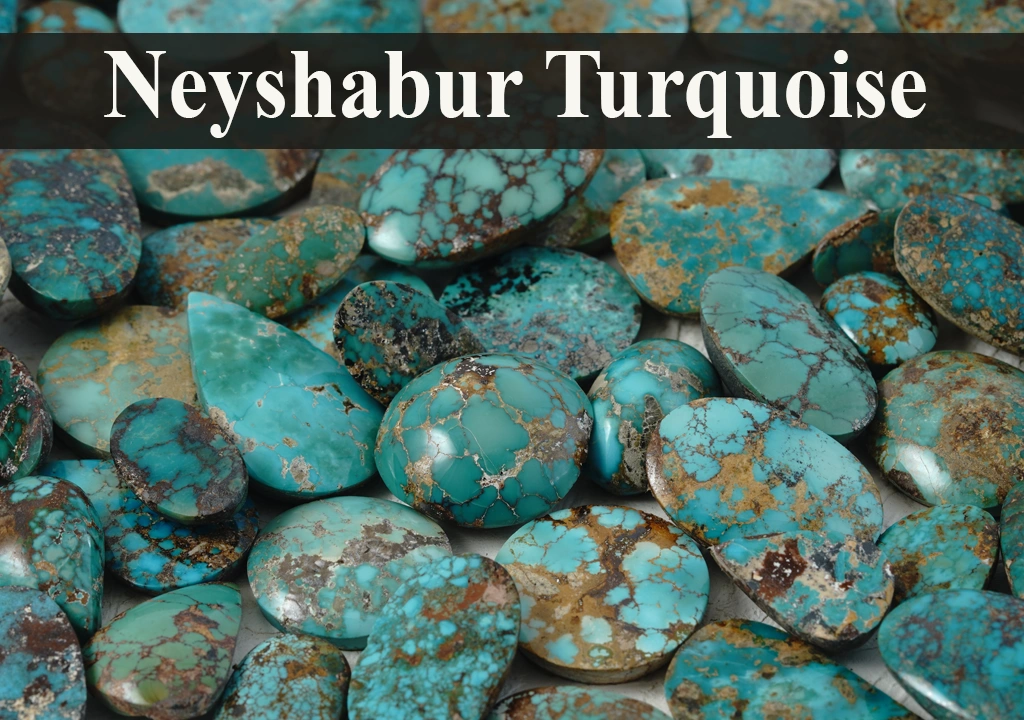
Neyshabur turquoise is the gemstone that gave “Persian turquoise” its name. For more than a thousand years, a single mountain in northeastern Iran — Raish Mountain, near the city of Neyshabur — has supplied the deep sky-blue stones that gemologists still use as a reference standard for turquoise color and quality. Yet outside Iran, the mine itself remains poorly understood, surrounded by decades-old rumors that it has closed or run dry.
This guide draws on the most detailed scientific field study of the mine to date — a 2021 report published by the Gemological Institute of America (GIA) in Gems & Gemology, based on a direct site visit in 2020 — together with market and lapidary sources, to give an accurate picture of Neyshabur turquoise: what it is, how it forms, how it is mined and graded, and how to recognize the real thing.
What Is Neyshabur Turquoise?
Neyshabur turquoise (also spelled Nishapur or Nishapour turquoise) is turquoise extracted from the Neyshabur mine, located in Iran’s Razavi Khorasan Province, about 53 km from the city of Neyshabur. It is part of Iran’s broader Persian turquoise tradition, and is Iran’s largest turquoise producer and its only mine dedicated specifically to turquoise — unlike Iran’s smaller Baghu (Semnan Province) and Shahr-e Babak (Kerman Province) deposits, which yield turquoise only as a byproduct of gold and copper mining.
Historically, Neyshabur’s output has been marketed worldwide simply as “Persian turquoise,” though Iran’s turquoise resources are not limited to this one mine. The name Neyshabur (نیشابور) refers to the historic Khorasan city near the mine and is pronounced roughly “ney-sha-BOOR.” In Persian, turquoise itself is called firouzeh (فیروزه), a word carrying connotations of victory and prosperity.
History and Age of the Neyshabur Mine
Turquoise use in Iran is extremely old. Archaeological finds from the Deh Luran Plain in western Iran — radiocarbon-dated turquoise beads from the Ali Kosh and Mohammad Jaffar burial sites — show the stone was worn as early as 7000 and 6500 BCE, respectively. It is worth noting, however, that gemologists have not linked these specific ancient artifacts to the Neyshabur deposit itself; the nearest known turquoise source to Deh Luran lies at least 900 km away.
What can be documented with confidence is that the Neyshabur mine has supplied the majority of Iranian turquoise for more than a thousand years, worked continuously at Raish Mountain using methods that, in places, date back centuries. Ownership has changed over time: previously held by various state and private organizations, the mine became a miners’ cooperative in 2003 and is today owned by shareholder-residents of the neighboring Ma’adan village.
Geology: How Neyshabur Turquoise Forms
Turquoise is a hydrous phosphate of copper and aluminum, with the chemical formula CuAl₆(PO₄)₄(OH)₈·4H₂O. The Neyshabur deposit sits at the eastern end of the Quchan–Sabzevar magmatic belt, a zone of intense volcanic activity in northeastern Iran active from the Cretaceous period, peaking in the Eocene (around 40 million years ago) and continuing into the Plio-Pleistocene (roughly 2 million years ago).
Turquoise formed here as a secondary mineral: hydrothermal fluids carrying copper and phosphate percolated through cracks and porous zones in altered volcanic rock (mainly trachyte and andesite) and subvolcanic intrusions, crystallizing over time into veins and nodules. This secondary mineral suite also includes chalcocite, hematite, covellite, and goethite alongside the turquoise.
Trace-element chemistry drives the color: stone with high copper and low iron/aluminum tends toward vivid sky blue, moderate iron shifts it toward blue-green, and higher iron with lower copper produces green tones — explaining why a single mine yields such a wide natural color range.
Inside Raish Mountain: The Mine's Three Tunnels
The modern Neyshabur mine consists of three active underground tunnel systems at Raish Mountain:
Main Tunnel (Asli)
The oldest and longest system, more than 2 km, reaching about 80 m underground at its lowest point (Chah Abdar); includes the Ardalani, Sabz, and Rokub sections.
Dom Tunnel
Persian for “second,” positioned 70 m above the Main tunnel; the smallest of the three but the most difficult to navigate, with a maze-like layout.
Zahk Tunnel
In the mine’s northeast section, split into Upper and Lower Zahk; home to the thickest turquoise veins in the entire mine (up to 4 cm) and currently the most productive, supplying more than 70% of total output.
Mining follows a stope-and-pillar method — an irregular variant of the standard room-and-pillar system, adapted because turquoise veins themselves run irregularly through the rock. Ore is loosened by controlled drilling and blasting, carried out only after miners have left the tunnels for the day, and the mine relies mostly on natural ventilation created by temperature differences between the surface and the underground passages.
From Rock to Rough: Production and Grading
With more than 200 workers, the Neyshabur mine produces an average of four tons of rough turquoise per month — roughly 40 to 42 tons per year — making it by far Iran’s largest turquoise producer.
Rough material is sorted at the mine into four quality categories:
Type | What It Is | Typical Use |
|---|---|---|
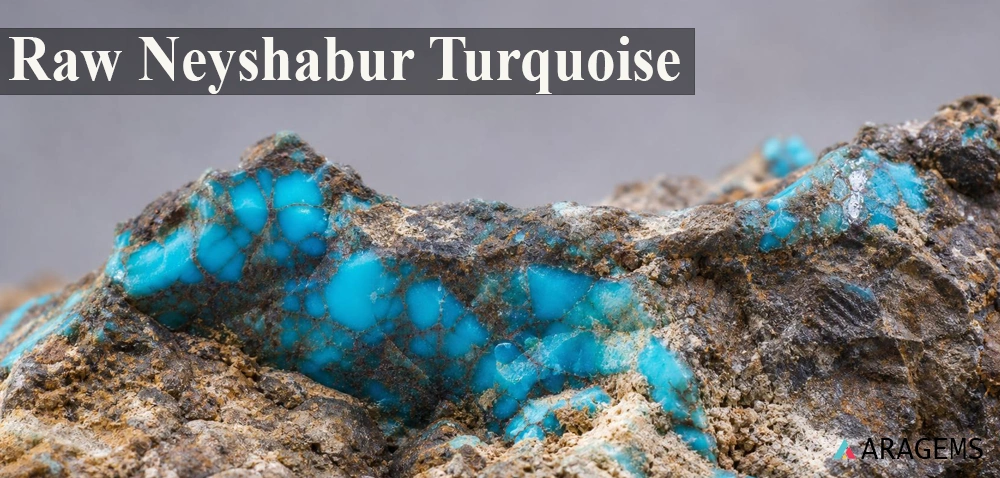
Type I — Nuggets & slabs | Dense, flawless pieces filling cavities and veins, separated from host rock; even color | Highest-grade cut stones, often untreated |
Type II — Host-rock attached | Veins and slabs still attached to matrix rock | Produces the prized spiderweb (Shajari) pattern |
Type III — Chalky turquoise | Porous, light blue / green / white material | Requires stabilization before cutting |
Type IV — Chips | Small pieces broken during extraction or transport | Inlay work and handicrafts |
Within each category, color is further graded on three levels: a vivid first grade, a lighter “half-color” (nim rang) second grade, and a pale third grade — though the trade acknowledges this grading is subjective and shifts with fashion, supply, and buyer taste.
Roughly 60% of Neyshabur’s output requires some form of treatment before cutting; only the finest first- and second-grade nuggets and host-rock pieces are typically sold and cut untreated. Three to four times a year, the cooperative holds an on-site auction where lapidaries, jewelers, and gem traders — mainly from Mashhad, Neyshabur, and Esfahan — bid on sorted bags of rough material. More than 300 lapidary workshops operate in and around Neyshabur and Ma’adan village, with cut stones exported mainly to buyers in Singapore, Kuwait, the UAE, and Spain.
Ajami vs. Shajari: The Two Faces of Neyshabur Turquoise
In the Iranian trade, cut Neyshabur turquoise is typically described using one of two traditional terms:
Ajami (Plain / Solid) — free of visible matrix, uniform sky-blue color, dense and hard; generally the most valuable and sought-after cut material.
Shajari (Veined) — displays the natural spiderweb or dendritic matrix pattern formed where turquoise remained attached to its host rock; color ranges from blue to greenish-blue, prized by collectors for its individuality.
Both are natural expressions of the same deposit rather than separate qualities: Ajami corresponds largely to Type I rough, while Shajari comes from Type II, host-rock-attached material. For a broader look at how these varieties fit among global turquoise sources, see our types of turquoise guide.
Is the Neyshabur Mine Closing? Separating Fact from Rumor
For decades, claims that the Neyshabur mine is “running out,” “about to close,” or in permanent decline have circulated among buyers — often repeated in ways that inflate prices or cast doubt on supply. The 2020 GIA field visit found the opposite: all three tunnels were active, exploration of a new tunnel (Khoraj) was underway to extend the mine further, and annual production remained steady at roughly 40 tons. The mine’s real challenge is not geological scarcity but market positioning — the generic “Persian turquoise” label has been diluted by inconsistent quality and pricing across sources, making it harder for genuine Neyshabur material to stand out internationally.
How Neyshabur Turquoise Compares to Other Sources
Turquoise evaluation ultimately comes down to quality rather than mine name, but each major source has a distinct profile. For a closer look at America’s best-known deposit, see our guide to Sleeping Beauty turquoise.
Property | Neyshabur (Iran) | Sleeping Beauty (USA) | Hubei (China) | Sinai (Egypt) |
|---|---|---|---|---|
Color range | Blue, blue-green, green | Sky blue | Blue, green | Blue-green |
Typical porosity | Low | Medium | High | Medium |
Matrix pattern | Ajami (clear) & Shajari (spiderweb) | Minimal | Often heavy | Variable |
Stabilization needed | Occasional (Type III only) | Sometimes | Often | Often |
Notable trait | Oldest continuously worked source; color reference standard | Mine closed in 2012; very uniform color | Large modern supply | Historic ancient source |
Cultural and Economic Significance
Turquoise has carried deep symbolic weight in Persian culture for millennia — associated with protection, purity, and prosperity, and historically used on mosque domes, manuscript covers, royal jewelry, and amulets. Neyshabur’s output, marketed globally under the umbrella term “Persian turquoise,” remains the backbone of Iran’s dedicated turquoise economy: the mine and its associated cutting workshops in Ma’adan village and Neyshabur city directly support mining families, more than 300 lapidary businesses, and a wider trade network extending to Mashhad, Tehran, and Esfahan.
How to Identify and Buy Authentic Neyshabur Turquoise
Because the term “Persian turquoise” is used loosely across the market, buyers should look for a vivid, even sky-blue to blue-green color without dye pooling in surface pores, and genuine weight and coolness to the touch — turquoise is denser than common imitations such as howlite or magnesite. Where possible, buy from a seller who discloses treatment status, since a majority of commercial-grade material on the market is stabilized. For a full step-by-step testing method, see our guide on how to identify authentic Persian turquoise.
Once you’re confident in what to look for, ARAGEMS carries a selection of natural turquoise cabochons sourced directly from Neyshabur turquoise, in both Ajami and Shajari grades.
FAQ
What does “Neyshabur” mean and how is it pronounced?
Neyshabur (نیشابور) is the name of the historic Iranian city in Razavi Khorasan Province nearest the mine, pronounced roughly “ney-sha-BOOR.” It is also spelled Nishapur or Nishapour in English.
Is Neyshabur turquoise rare?
Fine, untreated first-grade Neyshabur turquoise is genuinely limited — only a portion of the mine’s 40-ton annual output qualifies. However, the mine itself is not scarce or depleted; it remains Iran’s most productive turquoise source.
Is the Neyshabur turquoise mine closing?
No. A 2020 field visit documented by GIA found all three tunnels active and a new exploration tunnel underway, with production steady at roughly 40 tons per year. Claims of closure have circulated for decades without evidence.
What is the difference between Ajami and Shajari turquoise?
Ajami is matrix-free, solid-color turquoise prized for purity and density. Shajari displays the natural spiderweb matrix pattern from attached host rock. Both come from the same mine and are graded by different criteria, not by quality alone.
Does all Neyshabur turquoise require treatment?
No. About 60% of the mine’s output needs stabilization, mainly the porous, chalky (Type III) material. Top-grade nuggets and host-rock pieces (Types I and II) are typically cut and sold untreated.
How much does Neyshabur turquoise cost?
Price depends heavily on color grade, matrix pattern, treatment status, and cut quality rather than mine name alone. See our Persian turquoise price per carat guide for a detailed breakdown of pricing factors.
Conclusion
Neyshabur is not a mine in decline — it is the still-active source behind the color standard the entire turquoise trade measures itself against. Understanding its geology, grading system, and Ajami/Shajari varieties is the first step to buying with confidence, whether you’re choosing a single Ajami cabochon or sourcing genuine Iranian turquoise through our Turquoise Wholesale program.