
Blog
How to Identify Authentic Persian Turquoise: A Scientific Guide

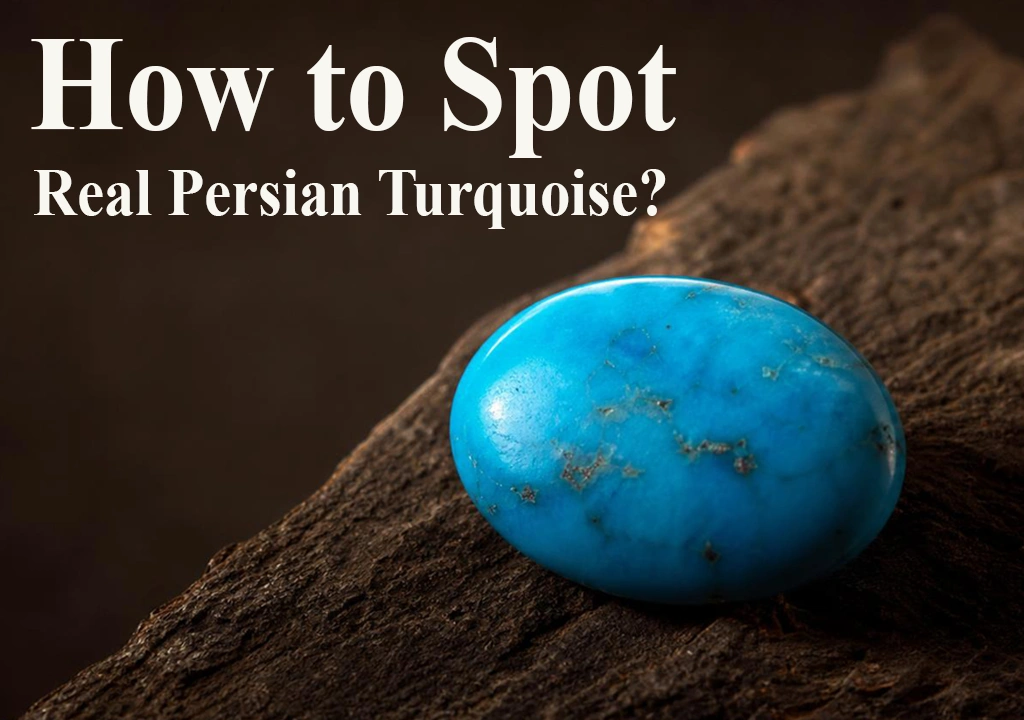
Most turquoise buying guides answer one question: is this stone turquoise at all, or is it dyed howlite, reconstituted block, or plastic? That question matters, and we cover it in full in our Real vs Fake Turquoise guide, with seven practical tests you can run at home. But for Persian turquoise specifically, there is a second, more expensive question buyers rarely get help with: is this stone genuinely from Iran, or is it non-Persian (or reconstituted) turquoise being sold under the Persian name because Persian material commands a premium? This guide is about that second question — verifying origin, not just mineral identity.
Why Persian Turquoise Needs Its Own Authentication Standard
Passing a basic authenticity test only confirms that a stone is turquoise — a hydrous copper-aluminum phosphate with the right hardness and structure. It says nothing about where that turquoise came from. Because genuine Persian turquoise, especially matrix-free Ajami material from Neyshabur, sells at a significant premium over Chinese, American, or reconstituted turquoise, mislabeling by origin is a distinct and common form of misrepresentation — one that a generic real-vs-fake test will not catch, because the stone in question may be 100% genuine turquoise mineral, just not from Iran.
This is the gap this guide fills. If you have not already ruled out non-turquoise imitations (dyed howlite, magnesite, plastic, or reconstituted block), start with our Real vs Fake Turquoise guide first, then come back here to verify origin specifically.
The Scientific Fingerprint of Genuine Persian Turquoise
Persian turquoise is a naturally occurring hydrous phosphate of copper and aluminum, CuAl₆(PO₄)₄(OH)₈·4H₂O, forming through the weathering and oxidation of copper-bearing host rock in arid conditions. On its own, this chemistry is identical to turquoise from any other deposit — Arizona, China, Egypt, or Iran. What differs by origin are structural and visual traits that mineralogists and experienced dealers use as circumstantial evidence of source:
- Density and porosity: Neyshabur and Kerman (Shahrbabak) material is typically denser and less porous than lower-grade Chinese and much reconstituted turquoise, which is why untreated Persian stones are prized for taking a finer polish without stabilization.
- Color range: Iranian deposits produce a range from pale green to a stable, saturated sky blue (“robin’s-egg” tone) with comparatively low iron content in the finest blue material; heavily iron-influenced greenish tones are more typical of some Chinese and American sources.
- Matrix chemistry: the host-rock veining in Iranian Shajar material tends toward brown, black, or golden mineral inclusions tied to the local volcanic host rock, rather than the sharper black “spiderweb” networks typical of Kingman or Bisbee material from Arizona.
Regional geological surveys of the Qochan–Sabzevar magmatic belt in northeastern Iran, where the Neyshabur deposit sits, along with published geological mapping of the Neyshabur mine district, describe this host-rock chemistry in detail — it is one reason gemological literature treats Neyshabur as a distinct, well-documented locality rather than a generic “Persian turquoise” source.
Ajami vs. Shajar: Matrix Signatures Specific to Persian Turquoise
Genuine Persian turquoise is sold under two recognized local classifications, and understanding both is central to spotting a mislabeled stone:
Ajami Turquoise
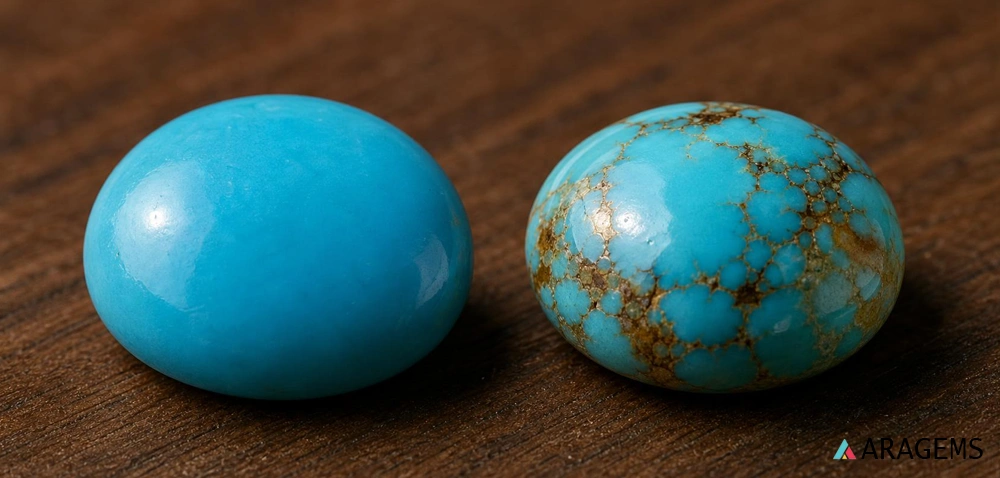
Solid, matrix-free blue material with even, natural color saturation. Because it is rare and valuable, Ajami is the type most frequently imitated — either with dyed howlite polished to a uniform finish, or with high-grade Chinese or reconstituted material dyed to match the Neyshabur blue. A key tell: genuine Ajami still shows subtle, organic tonal variation under magnification; dyed imitations tend toward a flat, almost printed uniformity.
Shajar Turquoise
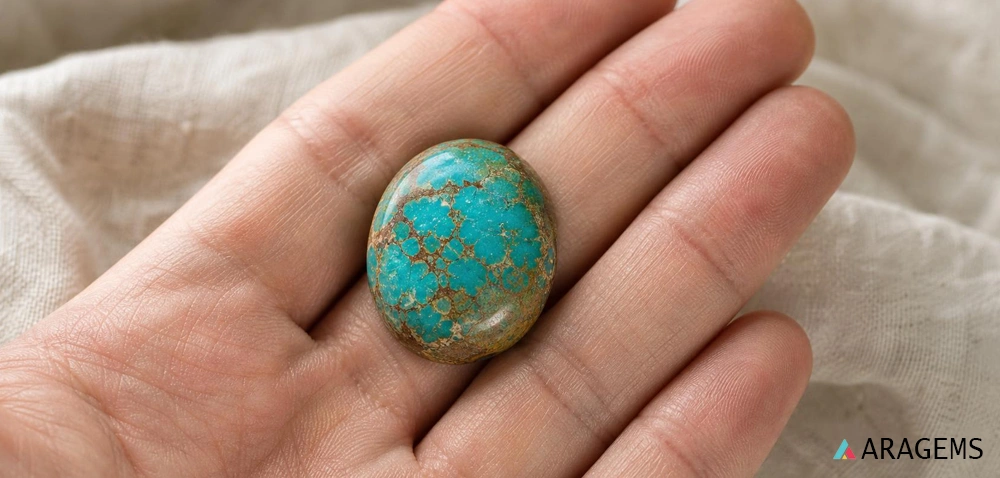
Veined material with natural brown, black, or golden matrix from the host rock. Because the matrix itself is the selling point, Shajar is harder to fake convincingly — but sellers sometimes market American spiderweb turquoise (Kingman, Bisbee) as “Persian Shajar” because the visual category looks similar to a non-specialist. The matrix pattern and color are the giveaway: Persian Shajar veining is generally softer-edged and follows the natural fracture pattern of the host rock, while American spiderweb turquoise typically shows a tighter, more geometric black network.
Common Ways Non-Persian or Fake Turquoise Gets Sold as “Persian”
These are the origin-specific misrepresentation patterns to watch for — distinct from the general fakes (plastic, dyed howlite) covered in our main authentication guide:
- Chinese turquoise resold as “Persian” or “Iranian.” China is the largest global producer, and a portion of Chinese material — often stabilized or lightly dyed — is relabeled as Persian to reach a higher price point, particularly in bulk online marketplaces.
- American turquoise marketed as “Persian style.” Kingman, Sleeping Beauty, or Bisbee material is sometimes described loosely as “Persian blue” or “Persian-grade” purely as a color descriptor, which can mislead buyers into thinking they are buying Iranian-origin stone.
- Reconstituted block turquoise dyed to a Neyshabur-matched blue. Crushed turquoise scrap bound with resin and dyed can be cut and marketed as “natural Irani Firoza” at a fraction of genuine Ajami pricing.
- Unverifiable “certificates of Iranian origin.” A certificate is only as reliable as the lab issuing it — a printed card with no accredited gemological lab behind it (GIA, Gübelin, AIGS, or a recognized national lab) proves nothing about origin.
A Practical Origin-Verification Checklist
Use this checklist specifically to evaluate origin claims — after you have already confirmed the stone is genuine turquoise mineral using the tests in our Real vs Fake Turquoise guide.
- Ask which mine, not just which country. A reputable seller can name Neyshabur, Kerman (Shahrbabak), or Damghan, and tell you whether the piece is Ajami or Shajar. Vague answers like “Persian style” or “Persian color” are a red flag.
- Check the price against the grade. Untreated, matrix-free Ajami from Neyshabur carries a real premium — see our Persian Turquoise Price per Carat guide for current benchmarks. A large, flawless-looking “Ajami” stone priced like bulk Chinese material is very unlikely to be genuine Iranian Ajami.
- Compare matrix behavior, not just color. Persian Shajar veining follows organic, softer-edged host-rock fracture lines; a tight, black, geometric spiderweb pattern is more consistent with American material than Iranian.
- Request documentation for high-value or matrix-free pieces. For any purchase where origin materially affects the price, ask for gemological lab paperwork (GIA, Gübelin, AIGS) rather than a seller-issued certificate alone.
- Buy from a source with a documented supply chain. ARAGEMS sources directly from named Iranian mines, including Neyshabur and Kerman, with treatment status disclosed rather than implied — browse verified stones in our persian turquoise stone, or request a wholesale quote for bulk sourcing with provenance via Turquoise Wholesale.
When to Send a Stone for Professional Origin Testing
Visual and price-based checks narrow the odds but cannot provide certainty on their own, particularly for loose stones without any purchase history. For high-value pieces — significant matrix-free Ajami cabochons, antique jewelry, or bulk wholesale lots — a gemological laboratory can go beyond a basic real-vs-fake test using standard instruments (refractometer, spectrometer, specific-gravity testing) and, in specialized research contexts, trace-element and geochemical analysis that can help narrow a stone’s likely geological source. This level of testing is not necessary for everyday jewelry purchases, but it is the only way to obtain real certainty on a significant acquisition.
Frequently Asked Questions
Is all blue turquoise from Iran considered “Persian turquoise”?
No. “Persian turquoise” refers specifically to turquoise mined in Iran — primarily Neyshabur, along with Kerman (Shahrbabak) and Damghan. Blue turquoise from China, the United States, or elsewhere is not Persian turquoise regardless of how closely its color matches, and describing it as “Persian blue” as a color name rather than an origin claim can still mislead buyers.
Can Chinese or American turquoise legally be sold as “Persian turquoise”?
No reputable seller should describe non-Iranian turquoise as Persian turquoise; doing so is a misrepresentation of origin, separate from any treatment disclosure. Terms like “Persian style” or “Persian color” used to describe non-Iranian stones should be treated as a caution flag, not a claim of origin.
Does a certificate guarantee a stone is genuinely Persian?
Only if it comes from an accredited, independent gemological laboratory. A seller-printed certificate with no lab name, methodology, or verifiable credentials behind it provides no real assurance of Iranian origin.
Is Ajami turquoise always more “authentic” than Shajar turquoise?
No — both are genuine Persian turquoise types; the difference is matrix, not authenticity. Ajami (matrix-free) is generally rarer and more valuable, while Shajar (veined) is equally genuine when it is truly from an Iranian source. Matrix presence or absence is a grading factor, not an authenticity test.
How is this different from your Real vs Fake Turquoise guide?
That guide answers whether a stone is turquoise at all versus howlite, magnesite, resin, or reconstituted material. This guide assumes the mineral identity question is settled and focuses specifically on verifying Iranian origin — a separate and, for Persian turquoise buyers, equally important question.
Conclusion
Authenticating Persian turquoise is really two separate checks: confirming the stone is genuine turquoise mineral, and confirming it actually originates from an Iranian deposit such as Neyshabur or Kerman. The first is covered thoroughly in our Real vs Fake Turquoise guide. The second — the one buyers most often skip — comes down to asking specific questions about mine and matrix type, checking price against grade, and insisting on real documentation for high-value pieces. For buyers who want that assurance built in from the start, ARAGEMS sources its turquoise directly from named Iranian mines with treatment and origin disclosed. Learn more about what sets this material apart in our What Is Persian Turquoise guide.