
Blog
Kerman Turquoise: The Copper Mine Behind Iran’s Other Persian Turquoise

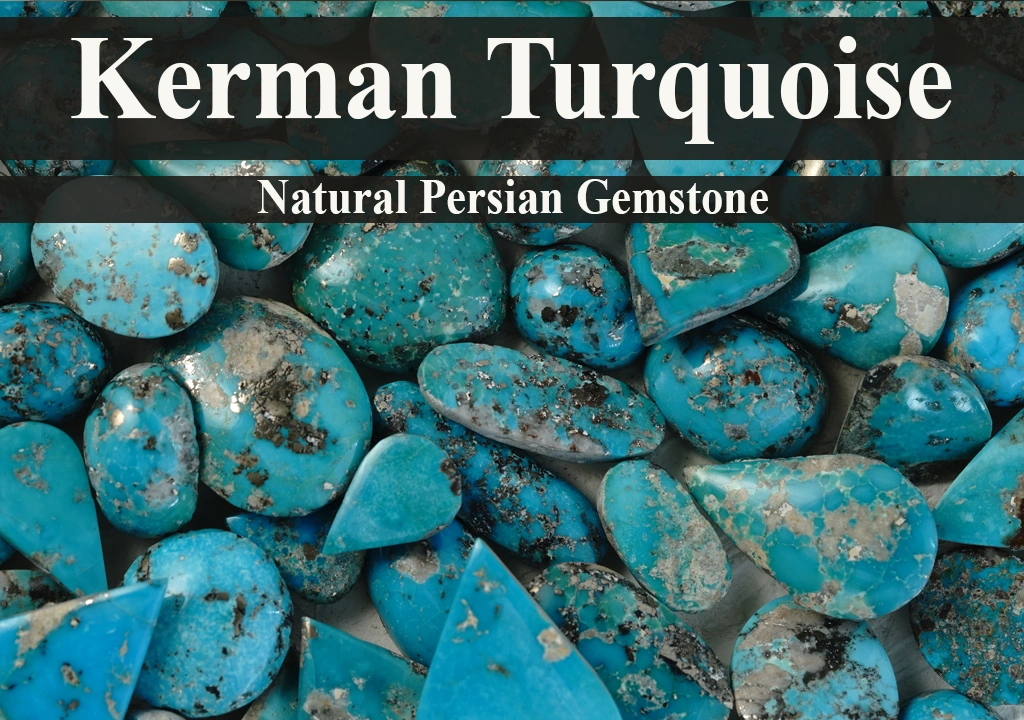
When people say “Persian turquoise,” they usually picture the deep sky-blue stone from Neyshabur. But Iran has a second, geologically very different turquoise source: the Shahr-e Babak district of Kerman Province, in south-central Iran. Unlike Neyshabur, which is a dedicated turquoise mine, Kerman’s turquoise is recovered as a byproduct of copper mining — mainly from the Meiduk open-pit mine, with a smaller amount from the nearby Chah Firouzeh deposit. That single fact explains almost everything distinctive about Kerman turquoise: its irregular supply, its association with pyrite and other copper-ore minerals, and why it plays a real but secondary role in Iran’s turquoise trade.
This guide draws on peer-reviewed mineralogy — a 2020 electron-microprobe study in The Canadian Mineralogist comparing Neyshabur and Meydook turquoise, and a 2022 study identifying a mineral never before documented in Persian turquoise — together with Iranian academic geological surveys and Mindat locality data, to explain what Kerman turquoise is, how it forms, how it differs from Neyshabur turquoise, and how to buy it with confidence.
What Is Kerman Turquoise?
Kerman turquoise is turquoise recovered from the Shahr-e Babak area of Kerman Province, most commonly from the Meiduk mine (also spelled Miduk, Meydook, or Meydouk), a large porphyry copper deposit about 42 km northeast of Shahr-e Babak city. A second, smaller source, Chah Firouzeh, lies roughly 32 km north of the same city and is geologically distinct from Meiduk, though both sit in the same district and both were opened as copper prospects — not turquoise mines. “Chah Firouzeh” literally translates to “turquoise well,” a name that reflects how the gem was discovered incidentally rather than sought out.
Locally, Shahr-e Babak is sometimes promoted as Iran’s “national city of turquoise” and is generally considered the country’s second most significant turquoise-producing district after Neyshabur. The comparison is easy to overstate, though: Neyshabur employs more than 200 people across three dedicated tunnels producing roughly 40 tons of rough turquoise a year. Kerman turquoise, by contrast, is extracted only when a vein happens to surface on an active copper bench, and is then sorted and sold through a local turquoise cooperative that works alongside the Meiduk mining operation.
Geology: How Kerman Turquoise Forms
At Meiduk, turquoise forms in Eocene volcanic and pyroclastic host rock — mainly andesite and trachyandesite — that has been intruded by multiple granodiorite bodies. According to Iranian geological research on the deposit, the process unfolds in stages: the breakdown of chalcopyrite (a copper-iron sulfide) releases copper and iron sulfates; sulfuric acid generated in this process reacts with apatite to produce phosphoric acid; and that phosphoric acid then reacts with copper-bearing solutions near aluminum-rich minerals such as plagioclase and clay minerals, precipitating turquoise. The stone typically forms as thin veins — usually a few millimeters and rarely more than about a centimeter thick — running both horizontally and vertically through the host rock, and occasionally as scattered grains rather than continuous veins.
Color follows depth and oxidation state, a pattern also seen at Neyshabur: material from the oxidized zone tends toward blue, while material from the transitional zone below it trends more green. Turquoise at Meiduk commonly occurs alongside malachite, azurite, chrysocolla, and chalcanthite — all secondary copper minerals that form under similar conditions.
Chah Firouzeh, the smaller nearby deposit, forms differently: its aluminum source is alunite, itself created by the alteration of kaolinite under sulfate-rich solutions, rather than the plagioclase/clay pathway at Meiduk. Because the relevant mineral zones are shallow at Chah Firouzeh, its turquoise forms close to the surface, and deeper deposits are not expected there. In practice, most of the material sold commercially as “Kerman turquoise” today comes from Meiduk rather than Chah Firouzeh.
Mining: A Copper Byproduct With an Unpredictable Supply
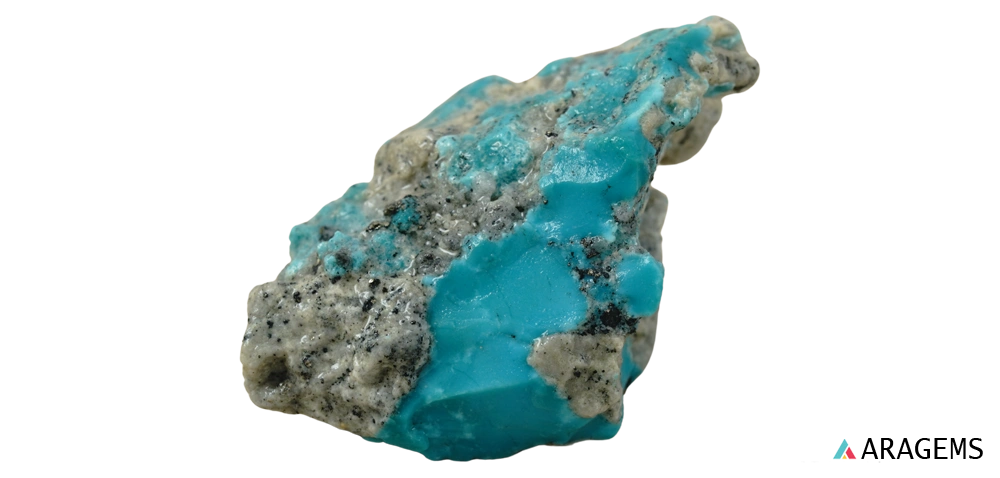
Meiduk is, first and foremost, an industrial open-pit copper mine, one of several major porphyry copper deposits in Kerman Province. Turquoise is not planned for or targeted; it turns up when a vein happens to be exposed on one of the mine’s working benches. According to trade reporting on the operation, output is accordingly irregular: when a turquoise-bearing bench is active, the associated cooperative may recover on the order of a few tons in a month, but in other months there can be no turquoise recovery at all. This stands in sharp contrast to Neyshabur, where mining is planned specifically around turquoise veins and output is comparatively steady year to year.
The practical effect for buyers is that Kerman turquoise supply is less predictable than Neyshabur’s, even though the underlying geological resource is not considered scarce. It also means grading and sorting standards are less formalized than at Neyshabur’s dedicated cooperative auctions, so provenance and seller transparency matter more when buying Kerman material.
Color, Texture, and the Pyrite Signature
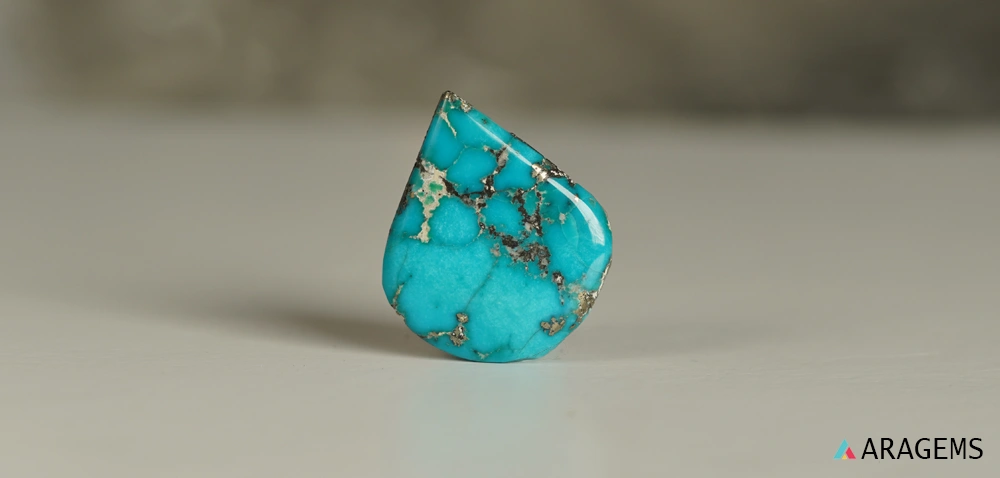
Kerman turquoise ranges from blue to blue-green and green, generally with a slightly softer, less saturated tone than top-grade Neyshabur Ajami material. One visually distinctive feature that shows up repeatedly in Kerman-sourced material — including several cabochons in ARAGEMS’ own inventory, explicitly labeled with names like “Pyrite Inclusions” and “Pyrite Matrix” — is the presence of small, brassy, metallic pyrite flecks embedded in the stone. Pyrite forms readily in the same copper-sulfide-rich environment that produces the turquoise itself, so its appearance in cut cabochons is a natural byproduct of Meiduk’s geology rather than a defect.
It is worth being precise here: pyrite is not unique to Kerman turquoise in a strict geological sense — it is also present as a primary ore mineral in Neyshabur’s host rock — but visible pyrite inclusions in a finished cabochon are reported far more often in Kerman material and are a useful, though not definitive, visual clue when trying to distinguish the two sources. The only reliable way to confirm origin is documentation from a transparent seller, not appearance alone (see “What the Mineralogy Really Shows” below).
What the Mineralogy Really Shows
A 2020 electron-microprobe study published in The Canadian Mineralogist (Gandomani, Rashidnejad-Omran, Emamjomeh, Vignola & Hashemzadeh) directly compared 17 samples from the Neyshabour and Meydook mines. The key finding is a useful dose of scientific humility: none of the samples analyzed were pure turquoise. Chemically, they fall along a turquoise–planerite solid-solution series, with minor involvement of chalcosiderite. Planerite — turquoise’s iron-and-aluminum-rich chemical cousin — was found to be more abundant in light-blue Meydook samples than in comparable Neyshabour material. Critically, though, the study concluded that distinguishing a stone’s mine of origin from its major-element chemistry alone is not reliably possible for blue and green turquoise of similar color. In other words: color and composition can overlap between Kerman and Neyshabur material, and neither buyers nor labs should assume origin from appearance or basic chemistry alone.
A separate 2022 mineralogical study went further, identifying hübnerite — a manganese tungstate mineral from the wolframite group — as an inclusion phase in turquoise from the Miduk mine specifically. This was reported as the first documented occurrence of hübnerite in Persian turquoise. It is a niche, specialist-level finding, but it underscores a broader point: Kerman turquoise is not simply “lower-grade Neyshabur turquoise” — it is chemically and mineralogically its own material, shaped by a different host-rock and ore-mineral environment.
Kerman vs. Neyshabur Turquoise: How They Compare
The two sources are often compared informally in the trade, sometimes with claims (such as fixed price multiples) that are not independently documented. The table below focuses on differences that are supported by mining and mineralogical sources rather than anecdote.
| Aspect | Neyshabur Turquoise | Kerman Turquoise |
|---|---|---|
| Mine type | Dedicated turquoise mine, three active tunnels | Byproduct of the Meiduk copper mine (plus small Chah Firouzeh deposit) |
| Supply pattern | Planned mining, ~40 tons/year, steady | Irregular; recovered only when veins appear on active copper benches |
| Typical host rock | Andesite/trachyte volcanic rock | Andesite/trachyandesite volcanic rock, cut by granodiorite intrusions |
| Common color range | Vivid sky blue to blue-green (Ajami), plus veined Shajari | Blue in oxidized zones, green in transitional zones; often softer saturation |
| Distinctive visual trait | Uniform color (Ajami) or spiderweb matrix (Shajari) | Pyrite inclusions reported more frequently in cut cabochons |
| Grading system | Formal 4-type, 3-grade cooperative system with auctions | Less standardized; sold through a local cooperative alongside copper production |
| Scientific status | Chemically a turquoise–planerite solid solution (2020 study) | Chemically a turquoise–planerite solid solution; unique hübnerite inclusion documented (2022 study) |
Why “Persian Turquoise” Sometimes Means Kerman, Not Neyshabur
In both Iranian and international markets, “Persian turquoise” is frequently used as a generic label rather than a precise indicator of mine origin. Iranian trade reporting has specifically noted cases of Shahr-e Babak (Kerman) turquoise being sold under the more prestigious Neyshabur name, and Iranian jewelers have separately raised concerns about counterfeit and dyed material — some from foreign sources imitating natural matrix patterns — further complicating the market. This is not a reason to avoid Kerman turquoise, which is a genuine, naturally formed gemstone with its own documented mineralogy; it is a reason to buy from a seller who discloses the mine of origin rather than defaulting to the umbrella term “Persian turquoise.”
How to Identify and Buy Authentic Kerman Turquoise
Because chemistry alone cannot reliably confirm origin (see above), buyers should rely on a combination of visual cues and seller transparency rather than a single test. Genuine Kerman material typically shows blue-to-green coloration with a slightly chalkier appearance than top-grade Neyshabur Ajami stones, and often — though not always — visible metallic pyrite flecks. As with any turquoise purchase, ask whether the stone is natural or stabilized, since porous, lower-grade rough from any Iranian source is commonly treated before cutting.
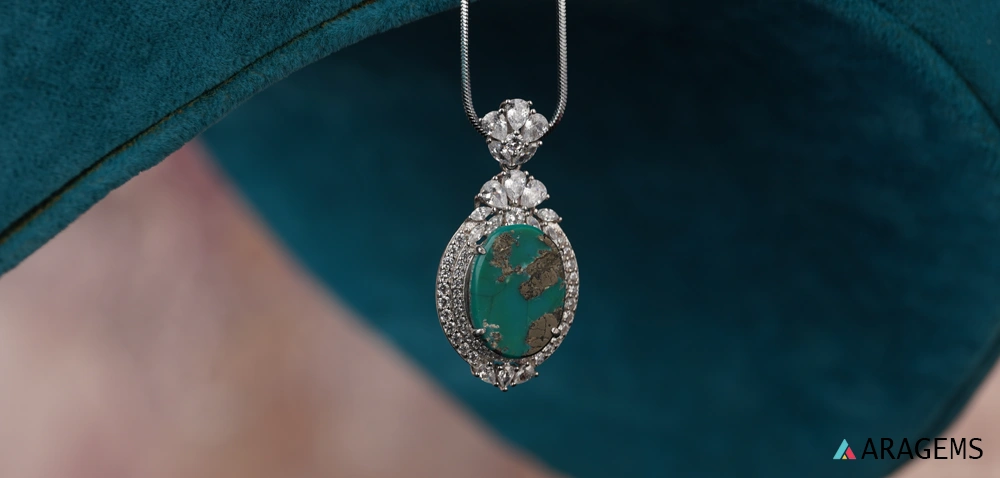
For a full step-by-step testing method that applies across Iranian turquoise sources, see our guide on how to identify authentic Persian turquoise. ARAGEMS carries a range of natural turquoise cabochons from the Kerman turquoise mine, including several with visible pyrite inclusions, alongside our Neyshabur turquoise stock, and a detailed price guide breaks down how grade, treatment, and matrix pattern affect cost across both sources.
FAQ
What is Kerman turquoise?
Kerman turquoise is turquoise recovered from the Shahr-e Babak district of Kerman Province in south-central Iran, mainly as a byproduct of the Meiduk open-pit copper mine, with a smaller amount from the nearby Chah Firouzeh deposit.
Is Kerman turquoise the same as Persian turquoise?
Yes — “Persian turquoise” is a broad term covering all turquoise mined in Iran, including both Neyshabur and Kerman material. Kerman turquoise is a genuine, distinct source within that category, not a separate or lesser gemstone.
How can you tell Kerman turquoise from Neyshabur turquoise?
Kerman material often shows a slightly softer color and, in many pieces, visible pyrite inclusions, while Neyshabur material tends toward more uniform, saturated blue (Ajami) or a defined spiderweb matrix (Shajari). However, a 2020 mineralogical study found that chemical composition alone cannot reliably confirm origin for similarly colored stones, so seller-disclosed provenance remains the most reliable method.
Why does Kerman turquoise sometimes have metallic gold flecks?
Those flecks are usually pyrite, a copper-sulfide-associated mineral common in the same host rock where Meiduk’s turquoise forms. It is a natural feature of the deposit rather than a flaw or an added material.
Is Kerman turquoise treated?
Some is, particularly porous or lower-grade rough, which is typical across Iranian turquoise sources. As with Neyshabur material, ask your seller whether a specific stone is natural or stabilized before buying.
How much does Kerman turquoise cost?
Price depends on color saturation, matrix and pyrite pattern, treatment status, and cut quality rather than mine name alone. See our Persian turquoise price per carat guide for a detailed breakdown of these factors.
Conclusion
Kerman turquoise is not a lesser imitation of Neyshabur turquoise — it is a genuinely different material, shaped by a different geological process (a copper mine's incidental byproduct rather than a dedicated deposit) and, per recent mineralogical research, containing at least one mineral inclusion never before documented in Persian turquoise. Understanding that difference is the key to buying it with confidence: look for transparent sourcing, expect a softer color range and possible pyrite inclusions, and treat mine-of-origin claims from any seller — Iranian or otherwise — with the same scrutiny you would apply to any gemstone purchase. Whether you’re selecting a single Kerman cabochon or sourcing larger quantities through our Turquoise Wholesale program, insist on the same standard of verified provenance and disclosed treatment status.