
Blog
Real vs Fake Turquoise: The Complete Guide to Spotting Genuine Turquoise

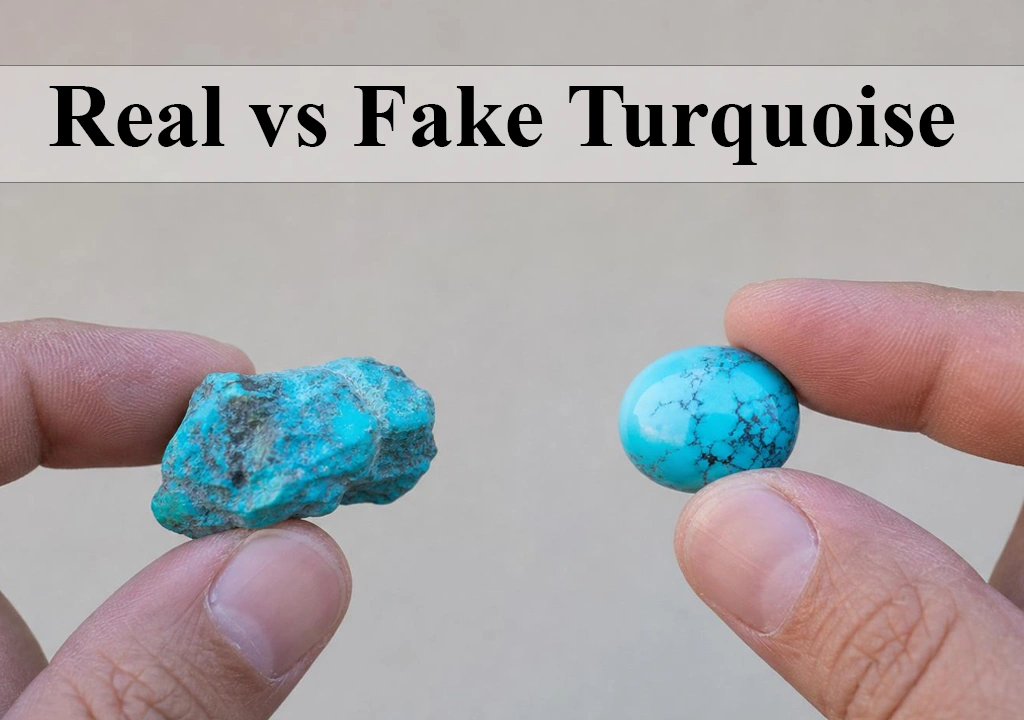
Turquoise is one of the most imitated gemstones on the market — which makes learning to tell real vs fake turquoise apart essential for any buyer, collector, or jeweler. Because natural, high-grade turquoise (especially fine Persian material) is scarce, a large share of what circulates commercially has been treated, reconstituted, or replaced entirely by other minerals, plastic, or dyed substitutes. This guide explains, in plain and scientifically grounded terms, what “real turquoise” actually means, which treatments are normal industry practice versus outright deception, and seven practical tests you can use before you buy.
What Does “Real Turquoise” Actually Mean?
Turquoise is a hydrous phosphate mineral of copper and aluminum, with the chemical formula CuAl₆(PO₄)₄(OH)₈·4–5H₂O. Genuine turquoise typically registers 5 to 6 on the Mohs hardness scale, a specific gravity of roughly 2.6 to 2.8, and a refractive index between 1.61 and 1.65. “Real” does not necessarily mean untreated: the gem trade distinguishes between natural (untreated) turquoise, treated turquoise (stabilized, dyed, or enhanced but still genuine mineral), and imitations that contain little or no actual turquoise. Only the last category is truly “fake.”
Why Fake and Treated Turquoise Are So Common
Fine, natural, matrix-free turquoise — such as high-grade Ajami material from Neyshabur — makes up only a small fraction of global supply. As demand for turquoise jewelry has grown, the market has filled the gap with three overlapping categories: legitimately treated turquoise (disclosed and priced accordingly), reconstituted turquoise made from crushed scrap, and outright imitations made from unrelated materials. None of this is inherently a problem as long as the material and any treatment are disclosed — the risk to buyers comes from non-disclosure and mislabeling.
Stabilized Turquoise
Around 90% of turquoise sold today has been stabilized — impregnated with a clear resin or wax under heat and pressure to fill natural pores and improve durability. Stabilization does not usually change color and is considered an accepted, disclosable treatment rather than a fake.
Zachery-Treated Turquoise
Documented by GIA in 1999, the Zachery process impregnates turquoise with potassium silicate rather than polymer, hardening the stone and deepening its color while leaving gemological properties very close to natural turquoise — making it genuinely difficult to detect without lab equipment.
Dyed or Color-Enhanced Turquoise
Natural or stabilized turquoise is sometimes dyed to intensify or even out its color. On its own this doesn’t make the stone fake, but undisclosed dyeing is considered a misrepresentation if the piece is sold as natural.
For readers who want certainty rather than guesswork, buy Persian turquoise directly from ARAGEMS: every stone is sourced from named Iranian mines such as Neyshabur and Kerman, with treatments disclosed rather than hidden. For larger orders, ARAGEMS also offers Turquoise Wholesale with custom quotes and verified provenance for jewelers and resellers.
Common Types of Fake and Imitation Turquoise
Unlike treated turquoise, the categories below are not turquoise at all, or contain so little of it that gemological bodies including GIA classify them as imitations.
Dyed Howlite and Magnesite
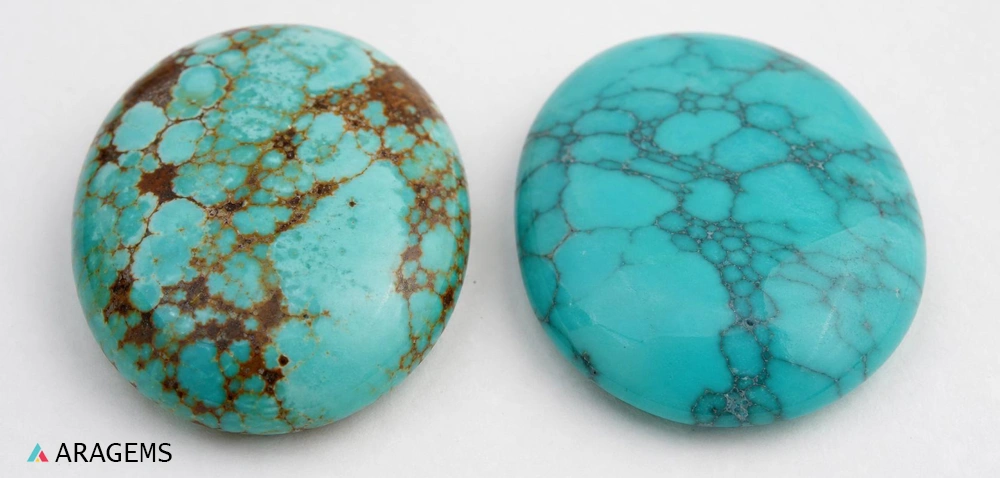
Howlite and magnesite are white-to-gray minerals with a similar veined appearance to turquoise once dyed blue or green. Both are softer than turquoise (roughly 3 to 3.5 on the Mohs scale versus 5 to 6), and the dye typically pools unevenly along natural cracks, producing an ink-like, overly uniform matrix rather than the organic, three-dimensional webbing seen in genuine stone.
Reconstituted (“Block”) Turquoise
Made from pulverized turquoise scrap mixed with dye and a plastic binder, then pressed into blocks and cut like natural stone. GIA classifies reconstituted turquoise as an imitation because it typically contains little genuine mineral content, even though the raw material originated as turquoise.
Plastic, Resin, and Glass Imitations
Manufactured substitutes have no natural mineral structure at all. They tend to feel unnaturally warm to the touch almost immediately, show swirl marks or air bubbles under magnification, and can show tool marks inconsistent with natural stone formation.
7 Practical Ways to Tell If Turquoise Is Real
- Examine the matrix and color. Genuine turquoise shows irregular, three-dimensional veining and natural color variation. Dyed imitations often show a flat, unnaturally uniform color with dye pooling in cracks.
- Check the weight and temperature. Natural turquoise feels notably cool and has real mineral heft; plastic and resin warm up quickly in your hand and often feel too light (or, if filled, unnaturally heavy).
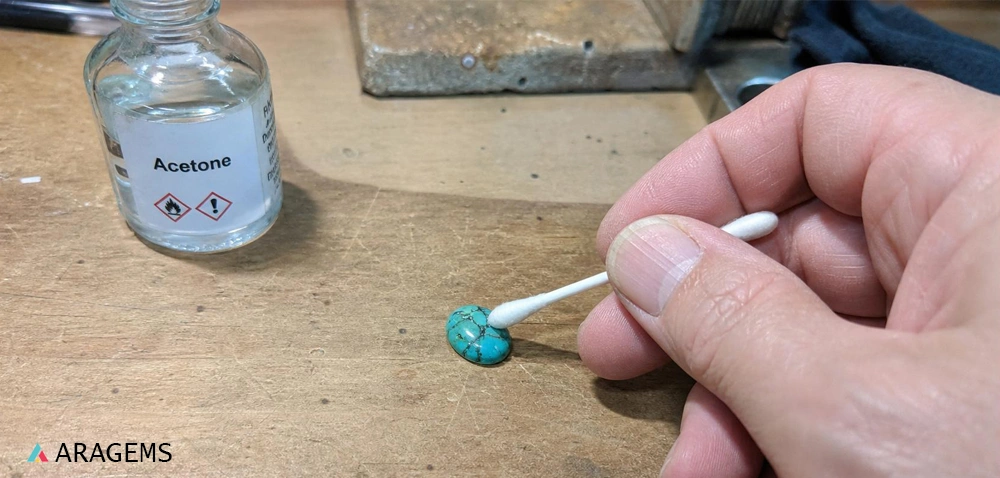
- Try a discreet acetone test. On an inconspicuous spot, a cotton swab lightly dampened with acetone that picks up color indicates dye — a strong sign of an imitation or undisclosed color treatment. Test cautiously, as this can also affect some finishes.
- Use the hot needle test with caution. A heated needle briefly touched to an inconspicuous spot will melt or release a plastic smell on resin/plastic imitations; genuine turquoise is unaffected. This test can mark the stone, so use it only when authenticity is in serious doubt.
- Test hardness carefully. Genuine turquoise (Mohs 5–6) resists a fingernail scratch but can be scratched by steel or a harder mineral. Howlite and magnesite (Mohs 3–3.5) scratch more easily.
- Be skeptical of a too-good price. Fine natural turquoise, especially matrix-free Persian Ajami material, commands a real premium. A large, vivid, flawless-looking stone at a bargain price is far more likely to be dyed howlite, magnesite, or reconstituted block turquoise.
- Get professional testing for high-value pieces. A gemologist can use spectroscopy, refractometry, or specific-gravity testing to confirm whether a stone is natural, treated, or an imitation — the only way to be certain on a significant purchase.
Real vs Stabilized vs Reconstituted vs Imitation: Quick Comparison
| Category | Is It Real Turquoise? | Key Traits | How to Detect |
|---|---|---|---|
| Natural, untreated | Yes — 100% | No polymer/wax added; color and matrix are entirely natural; rarest and most valuable grade | Provenance/certificate from a trusted source; professional gemological testing confirms no filler material |
| Stabilized | Yes — genuine mineral, treated for durability | Natural turquoise impregnated with clear resin/wax to reduce porosity; color usually unchanged | Disclosed by reputable sellers; detectable via spectroscopy; visually similar to natural stone |
| Dyed / color-enhanced | Yes, but color is altered | Natural or stabilized turquoise with added color to intensify or even out tone | Acetone swab test may lift dye; color often pools unevenly in cracks |
| Reconstituted (“block”) turquoise | No — classified as an imitation by GIA | Crushed turquoise scrap or powder bound with dye and plastic resin | Unnaturally uniform color and pattern; low density; often very low price |
| Dyed howlite / magnesite | No — a different mineral entirely | White/gray minerals dyed blue-green; softer and lighter than turquoise | Scratches more easily (Mohs 3.5); dye pools in veins; acetone test |
| Plastic, resin, or glass | No — not a mineral | Manufactured imitation with no natural structure | Feels warm quickly, unnaturally light or heavy, may melt/soften near a hot needle |
Why Authenticity Matters Even More for Persian Turquoise
Persian (Iranian) turquoise, particularly matrix-free Ajami material from Neyshabur, sits at the top of the global value scale — which makes it a frequent target for mislabeling and imitation. Because pricing for genuine Persian turquoise is driven heavily by origin, treatment status, and matrix type, verifying authenticity is directly tied to fair pricing. Buyers evaluating a purchase should review our detailed breakdown of how origin and treatment affect value in the Persian turquoise price per carat guide, and compare Persian material against other well-known sources in our full types of turquoise guide. For a deeper look at verifying Persian turquoise origin specifically — Neyshabur and Kerman mine traits, and Ajami vs Shajar signatures — see our how to identify authentic Persian turquoise guide.
Frequently Asked Questions About Real vs Fake Turquoise
Does real turquoise turn green over time?
Yes, and this is not automatically a sign of fakery. Natural turquoise can shift toward green with prolonged UV exposure, contact with skin oils, or dehydration of its structure. Some dyed imitations also fade or discolor, so a color shift alone isn’t a reliable authenticity test — it should be considered alongside hardness, matrix, and weight.
Is stabilized turquoise fake?
No. Stabilized turquoise is genuine mineral that has been treated to reduce porosity and improve durability. It is considered an accepted, disclosable treatment in the gem trade rather than an imitation — the key ethical requirement is that sellers disclose it.
How can you tell if turquoise is real without special tools?
Check the matrix pattern for natural, irregular veining, feel whether the stone is cool rather than warm to the touch, and be cautious of unusually low prices for large, vivid, unblemished stones. These checks won’t replace lab testing for high-value pieces, but they catch most common imitations.
Is all Persian (Iranian) turquoise natural?
No. Persian turquoise ranges from fully natural, untreated Ajami material to stabilized and, less commonly, dyed stones. Reputable Iranian sources disclose treatment status; buyers should always ask for this information, especially for higher-value matrix-free pieces.
Does real turquoise feel cold to the touch?
Yes, briefly. Like most natural minerals, genuine turquoise conducts heat away from your skin and feels cool for the first few seconds of contact, then warms gradually. Plastic and resin imitations tend to warm up almost immediately.
Conclusion
Telling real vs fake turquoise apart comes down to understanding three distinct categories: natural or treated genuine mineral, reconstituted material with little real turquoise content, and imitations made from entirely different substances. None of the simple tests above — matrix inspection, weight, acetone, hardness, or price sense — are foolproof on their own, but used together they catch the overwhelming majority of fakes in the market. For high-value purchases, especially rare natural Persian Ajami turquoise, professional gemological testing and a transparent, disclosed source remain the only way to be fully certain.