
Blog
White Buffalo Turquoise: A Complete Scientific Guide to the Stone, Jewelry, and More

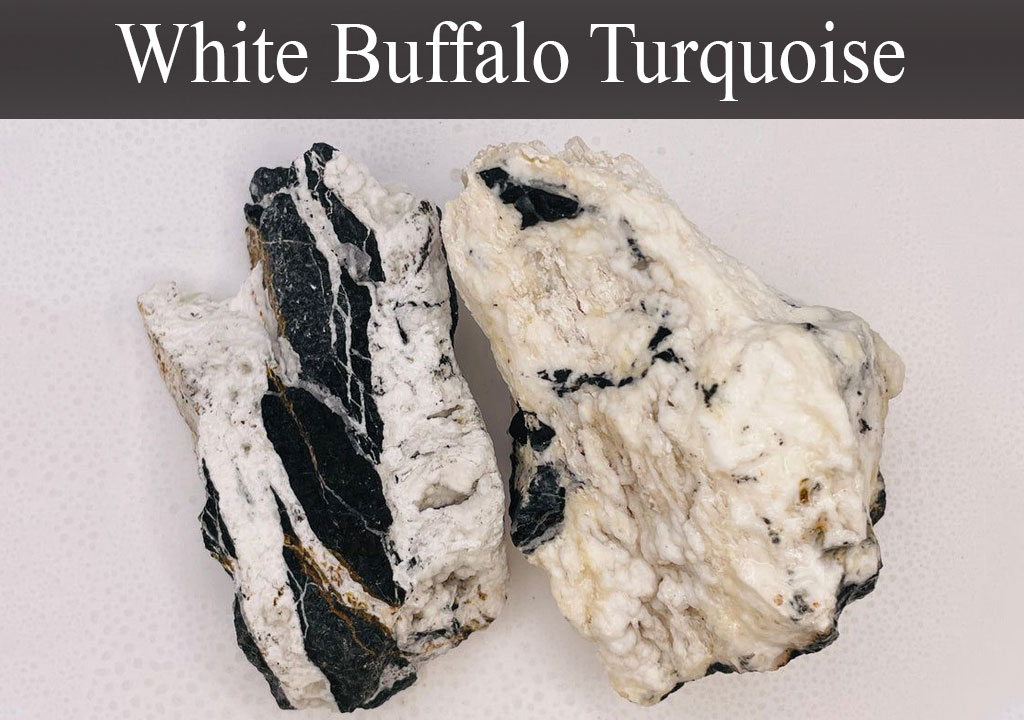
Despite its name, White Buffalo Turquoise is not a true turquoise from a scientific or mineralogical perspective. Unlike real turquoise—which is a copper-aluminum phosphate responsible for the iconic blue-green color—White Buffalo is made up primarily of calcite, dolomite, and often contains dark chert or iron oxide matrix. The absence of copper is what sets it apart chemically and visually.
If you're searching for genuine turquoise gemstones, especially the rich, natural blue and green varieties from traditional sources like Iran, be sure to check out our curated selection of natural stones and jewelry at Turquoise Stone
That said, White Buffalo has carved a niche for itself in the jewelry world for its striking appearance and symbolic value. This guide dives deep into the stone’s geology, uses, spiritual significance, comparison with Howlite, and care tips.
Quick Facts: White Buffalo Turquoise
Attribute | Detail |
|---|---|
Also Known As | White Turquoise, White Buffalo Stone |
Origin | Dry Creek Mine, Tonopah, Nevada, USA |
Discovered | 1993, by the Otteson family |
Composition | Calcite + Dolomite (± chert / iron-oxide matrix) |
Copper Content | None — not a true turquoise |
Mohs Hardness | ~3.5-4 |
Typical Color | White to creamy ivory with black, brown, or reddish veining |
What Is White Buffalo Turquoise?
White Buffalo Turquoise is a visually stunning white gemstone with dark veining, often used in Native American and Southwestern jewelry. It was discovered in Tonopah, Nevada, and is exclusive to that region. While it bears the name “turquoise,” it is not chemically the same and should be considered a distinct gemstone.
The stone is valued for its unique, high-contrast patterns and rarity, not for fitting into the scientific definition of turquoise.
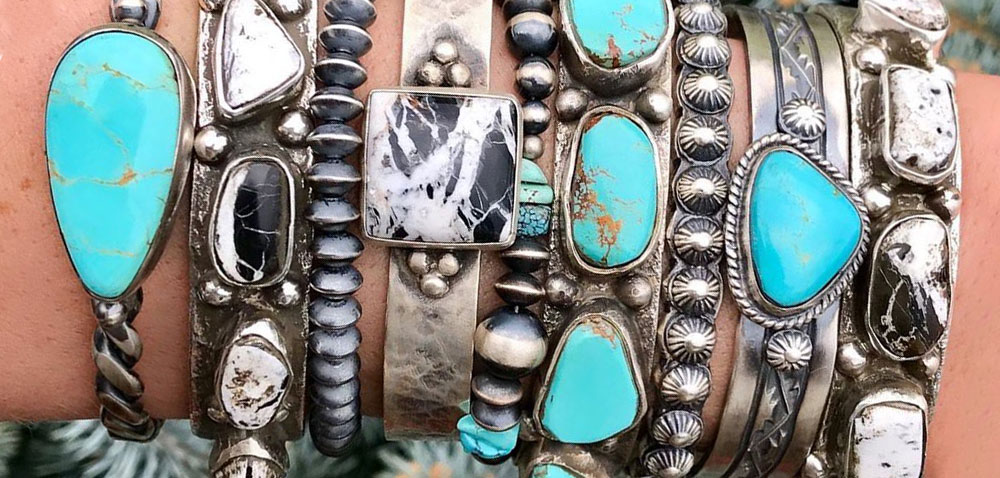
Is It Real Turquoise?
No, White Buffalo is not a real turquoise. True turquoise is defined by its copper and aluminum content, and is scientifically classified as CuAl₆(PO₄)₄(OH)₈·4H₂O. It is this copper content that gives turquoise its signature blue-to-green hues.
In contrast, White Buffalo is free of copper, and contains:
- Calcite (CaCO₃)
- Dolomite (CaMg(CO₃)₂)
- Trace amounts of iron oxide or chert
This makes it chemically and geologically different from turquoise, even if it shares aesthetic similarities.
For comparison, genuine Persian Turquoise from Iran is a true copper-aluminum phosphate, prized for the very copper content White Buffalo lacks. The two stones share only their popularity in jewelry — not their chemistry, origin, or classification.
Geological Composition and Formation
White Buffalo is formed in arid, calcium-rich environments. It develops when groundwater interacts with calcium- and magnesium-based minerals in host rock formations. Its limited availability—largely restricted to a single mining claim—adds to its mystique and market value.
Key components:
- Calcite: Gives the stone its bright white base
- Dolomite: Adds structural strength and slight color variation
- Matrix (chert or iron oxides): Creates the iconic dark veining
Color, Veining, and Appearance
The beauty of White Buffalo lies in its stark contrast:
- Base Color: White or creamy ivory
- Veining: Random black, brown, or reddish patterns
- Texture: Opaque and smooth when polished
No two stones are exactly alike, which makes each piece of jewelry uniquely special.

Popular Jewelry Styles
White Buffalo’s high contrast makes it a standout in both minimalist and bold jewelry designs. Common applications include:
- White Buffalo Turquoise Necklaces
- White Buffalo Turquoise Bracelets
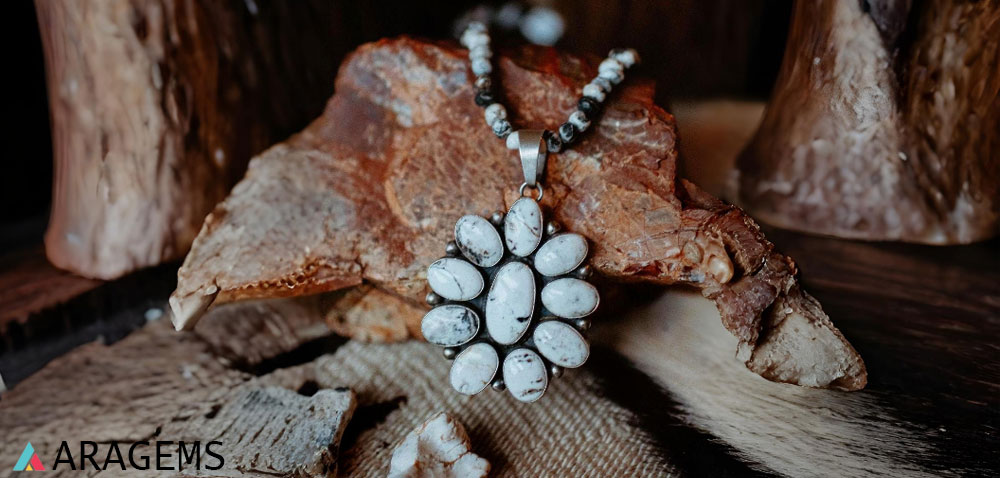
- White Buffalo Turquoise Pendants
- White Buffalo Stone Rings
- Earrings and Statement Pieces
It is frequently set in sterling silver and handcrafted by Native American artisans from tribes such as the Navajo and Zuni.

Raw vs. Polished White Buffalo
- Raw Stones: Uncut and unpolished; often used for spiritual purposes or custom jewelry
- Polished Stones: Cut, shaped, and highly valued for fine jewelry
Polished pieces command higher prices due to the labor-intensive crafting process, while raw stones are popular among collectors and holistic practitioners.
Symbolism and Spiritual Meaning (Short Summary)
In Native American tradition, particularly Lakota culture, the White Buffalo symbolizes sacred prophecy, purity, and rebirth. The stone is said to:
- Enhance spiritual balance
- Aid in intuition and truth-seeking
- Represent peace and renewal
👉 For a complete breakdown of metaphysical properties, check out our dedicated article:
White Buffalo Turquoise Meaning: Symbolism, Spiritual Properties, and More
How to Identify Genuine White Buffalo
Here’s how to spot real White Buffalo and avoid common fakes:
For authentication techniques that apply across turquoise varieties more broadly, see our complete guide: Real vs Fake Turquoise
Feature | Authentic White Buffalo | Fake or Dyed Imitation |
|---|---|---|
Color | Natural white with random dark veining | Uniform or too-perfect patterns |
Density | Harder and denser than howlite | Softer, lighter |
Veining | Irregular, naturally formed matrix | Repetitive or artificial-looking |
Source | Tonopah, Nevada (check origin) | Often mass-produced, undisclosed |
White Buffalo vs. Howlite (Scientific Comparison)
Although visually similar, White Buffalo and Howlite are different in composition, hardness, and market value.
Property | White Buffalo | White Howlite |
|---|---|---|
Composition | Calcite + Dolomite | Calcium Borosilicate Hydroxide |
Veining Color | Black, brown, or reddish | Typically light gray |
Hardness (Mohs) | ~3.5-4 | ~3.5 |
Rarity | Relatively rare | Common and widely available |
Jewelry Value | Higher | Lower, often used as turquoise imitation |
👉 Interested in an in-depth comparison? Read our full article:
White Buffalo Turquoise vs Howlite: Value, Jewelry, Healing Properties, and More
Care and Maintenance
Even though it’s durable, White Buffalo needs proper care to preserve its beauty:
- Avoid chemicals (household cleaners, chlorine)
- Keep dry – prolonged exposure to water may weaken the stone
- Store separately – to avoid scratching softer stones or being scratched by harder gems
- Clean gently – use a soft, dry cloth only
Where to Buy Authentic Jewelry
When shopping for White Buffalo jewelry, look for sellers who:
- Disclose stone origin
- Offer certification of authenticity
- Provide details about treatment (if any)
Best sources include:
- Native American jewelry markets
- Boutique gemstone retailers
- Verified sellers on Etsy, eBay, or artisan platforms
- High-end jewelry stores with transparency on materials
Frequently Asked Questions
Is White Buffalo Turquoise real turquoise?
No. Scientifically, real turquoise is a copper-aluminum phosphate. White Buffalo contains no copper and is composed of calcite and dolomite, so it is a distinct gemstone that shares the turquoise trade name by tradition, not by chemistry.
Is White Buffalo Turquoise natural or man-made?
It is a natural mineral mined from a single claim near Tonopah, Nevada. It is not synthetic, though — like most gem material sold under a trade name — buyers should confirm origin with the seller, since “white buffalo” is sometimes used loosely for dyed howlite or magnesite.
Is White Buffalo Turquoise more valuable than regular turquoise?
This is a matter of market demand, not scientific value. Collectors pay a premium for White Buffalo because of its rarity and striking pattern, but within gemology, true copper-bearing turquoise remains the reference standard for the “turquoise” classification.
How durable is White Buffalo Turquoise in jewelry?
At roughly 3.5-4 on the Mohs scale, it is softer than true turquoise and needs the same care as other semi-porous stones: avoid harsh chemicals, prolonged water exposure, and storage alongside harder gems that could scratch it.
Does White Buffalo Turquoise have spiritual meaning?
In Lakota and other Native American traditions, the white buffalo is a symbol of prophecy, purity, and renewal, and the stone is associated with those meanings. This is a cultural and spiritual belief, not a scientific property of the mineral itself.
Final Thoughts
While White Buffalo Turquoise is not technically turquoise, it holds immense value in both the fashion and spiritual worlds. Its rarity, distinctive appearance, and cultural connections make it a beloved gemstone for collectors, artisans, and jewelry lovers alike.
But if you’re looking for genuine turquoise, rich in history and color—especially from Iran, the global center of traditional turquoise—be sure to explore our full collection at Aragems